RBI Resumes Rate Hikes: A New Era of 'Calibrated Tightening' for India's Economy
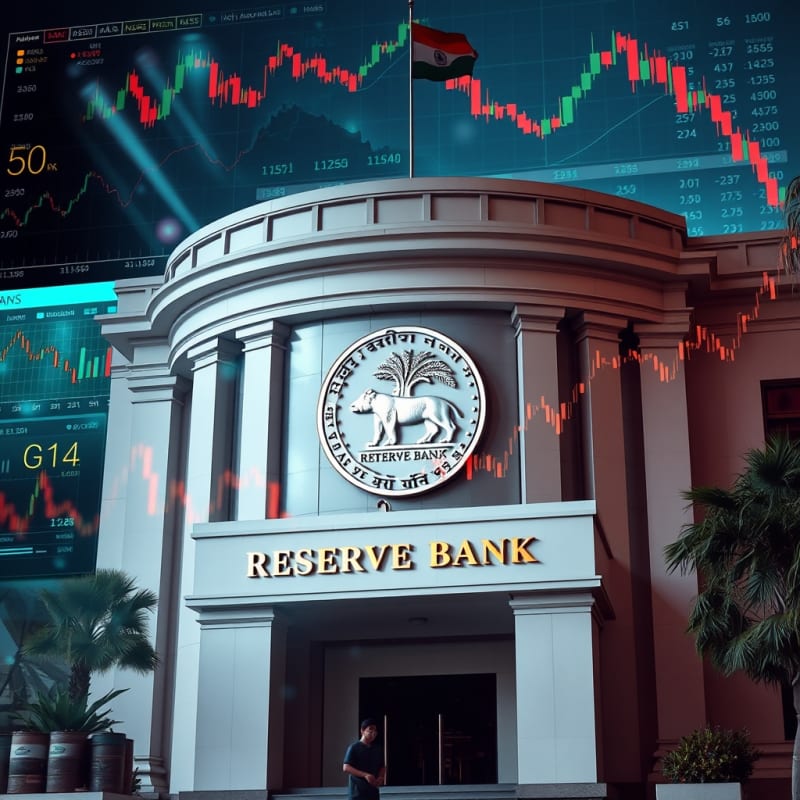
RBI Resumes Rate Hikes: A New Era of 'Calibrated Tightening' for India's Economy
In a significant shift signalling a renewed focus on inflation containment, the Reserve Bank of India's (RBI) Monetary Policy Committee (MPC) on October 7, 2026, voted unanimously to increase the policy repo rate by 25 basis points to 5.50%. This marks the first rate hike by the central bank since February 2023, accompanied by a decisive change in its monetary policy stance from 'neutral' to 'calibrated tightening'. The move, coming after an extended pause, underscores the MPC's growing concerns over persistent inflationary pressures and evolving global headwinds, even as India’s economic growth trajectory remains robust.
The Imperative for Tightening: Inflation and Global Volatility
RBI Governor Sanjay Malhotra outlined three primary reasons underpinning the committee's decision. Firstly, inflation in India has become more 'generalized and persistent', extending beyond seasonal food price shocks. The consumer price index (CPI) inflation had risen to 4.8% in August 2026 from 4.5% in July 2026, with core inflation also showing signs of broadening price pressures. The MPC projects CPI inflation to average 5.2% for FY27, with Q3 and Q4 FY27 forecasts standing at 6.0% and 5.7% respectively, breaching the upper tolerance band of 6% in the third quarter.
Secondly, supply-side risks remain elevated due to the re-escalation of the West Asia conflict in September and the consequent hardening and volatility in global crude oil and commodity prices. The RBI's baseline assumption for crude prices for the second half of 2026-27 is a concerning US$95/bbl, which directly impacts India's import bill and domestic fuel costs. This external factor exacerbates domestic price pressures, making the inflation fight more challenging.
Thirdly, a relatively high growth momentum in the Indian economy provided the necessary space for monetary policy tightening. The RBI maintained a positive outlook on growth, revising its real GDP growth projection for FY27 upwards to 7.1%, from 6.7% in the August policy. This revised forecast aligns with the World Bank's recent upgrade of India's FY27 growth projection to 7.1%, citing strong domestic demand and exports. The economy's resilience, with real GDP growing 7.8% in Q1 FY27, offered the MPC confidence to prioritize inflation management without significantly derailing the growth trajectory.
Implications for the Financial Landscape
The shift to 'calibrated tightening' signals that rate cuts are 'off the table in the near term', with the MPC's resolution indicating that future policy action can only be a rate hike or a pause. This forward guidance has immediate ramifications across financial markets:
- Lending and Borrowing Costs: The direct consequence of a repo rate hike is an increase in banks' lending rates. For retail borrowers, this translates to higher Equated Monthly Instalments (EMIs) on home loans, auto loans, and personal loans. Businesses will also face elevated borrowing costs, potentially impacting investment decisions.
- Bond Markets: Indian government bond yields have shown a partial response to higher global energy prices and yields, reflecting prudent fiscal management. However, the RBI's hawkish stance, coupled with global tightening cycles, will likely keep bond yields under upward pressure. Markets are already pricing in further tightening, with expectations of 25-50 bps of RBI tightening by February 2027.
- Equity Markets: Higher interest rates typically reduce the attractiveness of equities by increasing the cost of capital for companies and providing a more appealing alternative in fixed-income investments. Indian equities have already seen significant foreign portfolio investor (FPI) outflows, with ₹31,282 crore withdrawn in the first four sessions of October, compounding the ₹35,857 crore selling in September. Total FPI withdrawals in 2026 have reached ₹2.91 lakh crore, making it the worst year since 2008. This accelerating FPI selling is primarily attributed to inflation concerns, rising crude prices, elevated US Treasury yields, and a weaker rupee.
- Currency: A rate hike can offer support to the Indian Rupee (INR) by making it more attractive for foreign investors to hold rupee-denominated assets, thereby helping to mitigate imported inflation, particularly from crude oil.
Looking Ahead: Navigating a Complex Global Environment
The RBI's decision underscores its commitment to maintaining price stability, a critical prerequisite for sustained economic growth. While the Indian economy demonstrates resilience, as evidenced by strong services and manufacturing PMI data (September Services PMI at 55.2 and Manufacturing PMI at 55.1), the external environment presents considerable challenges. Geopolitical uncertainties, volatile commodity markets, and tightening global financial conditions will continue to influence domestic policy.
The 'calibrated tightening' approach suggests that the RBI will remain agile, responding to evolving inflation and growth dynamics. For investors, professionals, and businesses, this implies a period where capital costs will remain elevated, and a careful assessment of debt-funded expansion plans will be crucial. The focus will shift increasingly to earnings resilience and companies with robust balance sheets, capable of navigating a higher interest rate regime and absorbing persistent input cost pressures. The December 2026 MPC meeting will be closely watched for further signals on the trajectory of monetary policy.
Balaji K


Comments
Post a Comment