India's Monetary Policy Crossroads: RBI Grapples with $133 Billion Liquidity Surge and Inflationary Pressures
The Unprecedented Inflow and its Macroeconomic Ripples
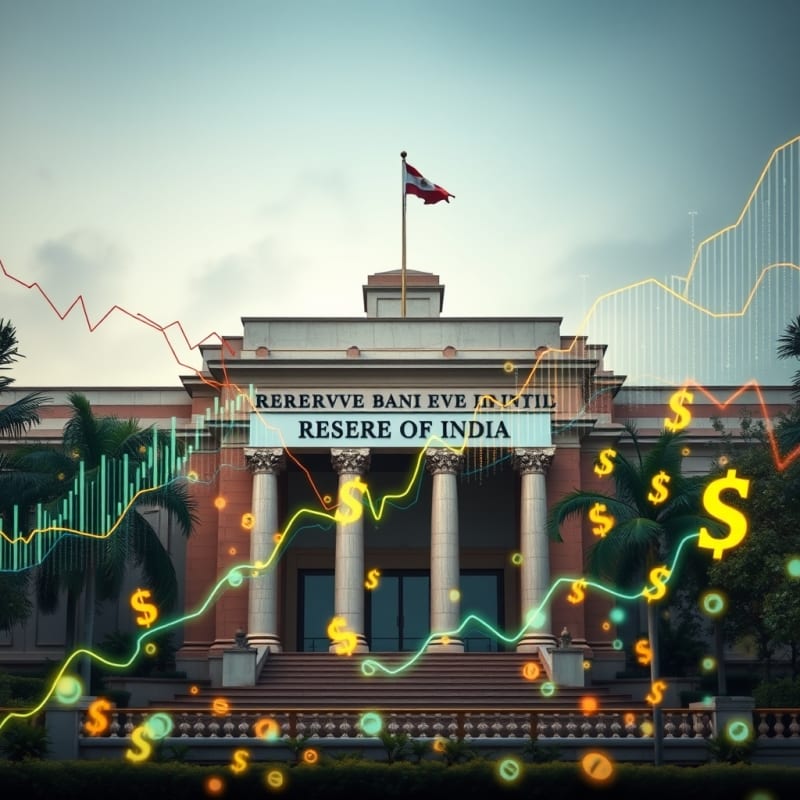
The Indian financial landscape is currently navigating a complex period, marked by an extraordinary surge in liquidity that has put the Reserve Bank of India (RBI) at a critical monetary policy crossroads. A record $133 billion inflow from the Indian diaspora has left commercial banks awash with cash, pushing overnight interbank rates significantly below the RBI's benchmark policy rate of 5.25%. This influx, while indicative of strong external confidence in the Indian economy, presents a formidable challenge for the central bank as it balances growth imperatives with the escalating threat of inflation.
This liquidity deluge stems primarily from the success of the RBI's earlier measures to attract dollar flows, aimed at bolstering foreign exchange reserves and stabilizing the rupee amidst global uncertainties. Just months ago, the central bank actively sought these inflows, and its efforts have clearly yielded results, with India's foreign exchange reserves nearing $800 billion, positioning them as the world's fourth largest.
The Inflationary Dilemma: Beyond Food and Fuel
The timing of this excess liquidity could not be more challenging. India is simultaneously grappling with persistent inflationary pressures, driven notably by rising food costs and elevated global crude oil prices. Brent crude, for instance, saw its third consecutive monthly rise in September, hovering above $104 a barrel. While earlier assessments categorized inflation largely as a 'food and fuel story,' the confluence of robust domestic demand, accelerating credit growth, and now, abundant systemic liquidity, raises concerns about a broader generalization of price pressures across the economy.
The RBI finds itself in a precarious position. Allowing overnight rates to remain significantly below the policy rate effectively translates into an inadvertent monetary easing, counteracting its stated stance and potentially exacerbating inflationary expectations. Economists at leading financial institutions, including Citigroup Inc. and JPMorgan Chase & Co., have voiced concerns about the potential for a “credibility cost” for the RBI and a “mispricing of risk” in asset markets if this excess liquidity remains unchecked.
RBI's Measured Response and Future Trajectory
In response to this evolving scenario, the RBI has already initiated steps to absorb some of the surplus liquidity. It has drained over ₹1 trillion ($10.4 billion) from the system through a combination of bond sales and other liquidity management operations. However, market participants widely anticipate further aggressive measures to sterilize the excess cash. Options include increased intervention in the foreign exchange market to manage the rupee's volatility – which has seen the currency depreciate over 6% year-to-date against the US dollar – and potentially, further bond sales or even a hike in the cash reserve ratio (CRR) as a last resort.
The bond market has already reacted to the heightened anticipation of a more hawkish RBI. Benchmark 10-year yields climbed nearly 20 basis points last month, nearing a two-year high, reflecting investors' expectations of higher interest rates. The upcoming monetary policy committee (MPC) meeting is therefore keenly awaited, with a growing chorus of analysts predicting an interest rate hike to anchor inflation expectations and restore the efficacy of monetary policy transmission.
Implications for Investors and Businesses
For investors, the prospect of a hawkish RBI signals a potential shift in the interest rate cycle. Higher policy rates would translate to increased borrowing costs for businesses, potentially impacting corporate earnings and investment plans. Sectors sensitive to interest rates, such as real estate, automobiles, and capital-intensive industries, will require close monitoring.
Conversely, higher deposit rates could make fixed-income instruments more attractive, possibly diverting funds from equity markets, which have already witnessed foreign institutional investor (FII) selling pressure in recent months. FPIs have withdrawn nearly ₹21,000 crore from the equity market in September alone. However, domestic institutional investors (DIIs) have shown resilience, with domestic money holding the line through a genuinely rough year, suggesting a healthier, more structural bid in the market.
Businesses, particularly those with significant foreign currency exposure, will also need to factor in continued rupee volatility and the potential for further depreciation, impacting import costs and hedging strategies. The RBI’s challenge is to manage this liquidity effectively without unduly stifling the strong economic momentum seen in India’s manufacturing sector, which recently hit a seven-month high in September with its Purchasing Managers' Index (PMI) rising to 55.1 from 52.8 in August, driven by robust domestic and export demand.
In essence, the RBI faces a delicate balancing act: reining in inflation and managing excessive liquidity without derailing India's growth trajectory. The decisions made in the coming weeks will have profound implications for the cost of capital, market sentiment, and the overall macroeconomic stability of India. Financial professionals and businesses must remain vigilant and adapt their strategies to navigate this evolving monetary policy landscape.
Balaji K


Comments
Post a Comment