Navigating the Crosscurrents: FPI Outflows Challenge India's Resilient Economic Narrative Amid Global Headwinds
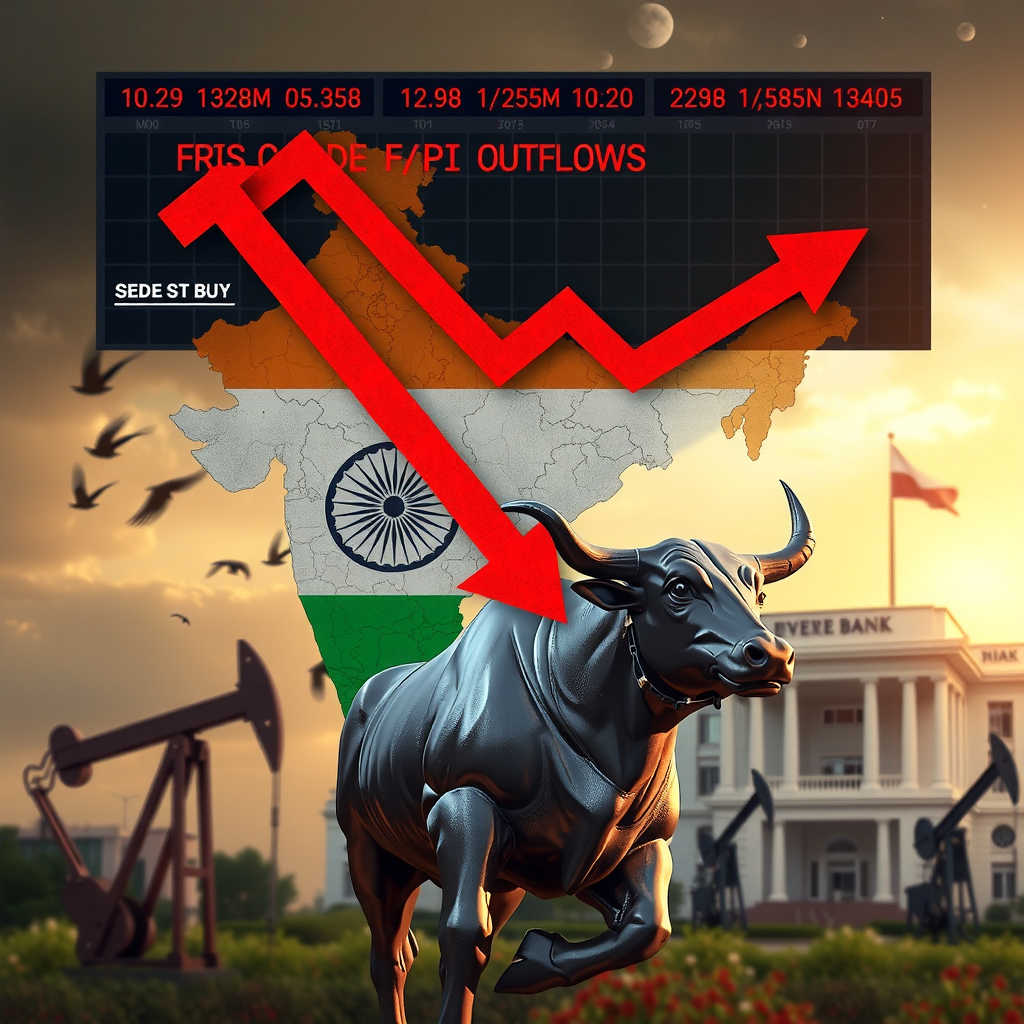
Persistent FPI Outflows Weigh on Indian Equities and Rupee
The Indian financial markets have recently witnessed a notable deceleration in foreign capital inflows, with Foreign Portfolio Investors (FPIs) continuing their divestment from domestic equities. May 2026 has seen significant outflows, amounting to approximately ₹27,048 crore so far this month, contributing to a substantial year-to-date withdrawal of roughly ₹2.2 lakh crore from the Indian equity market. This persistent selling pressure underscores a growing caution among global investors, driven by an intricate interplay of macroeconomic and geopolitical factors.
The primary drivers behind these outflows are multifaceted. Geopolitical tensions, particularly the ongoing conflict in West Asia, have injected a fresh wave of uncertainty into global markets, leading to elevated crude oil prices and tighter financial conditions worldwide. India, being a significant net importer of crude oil, is particularly vulnerable to such price volatility, which fuels inflationary pressures and impacts the nation's current account dynamics. Furthermore, the allure of higher yields in developed markets and a global reallocation of capital towards artificial intelligence (AI)-focused companies are diverting funds away from emerging markets like India.
UN Revises India's Growth Forecast Downward Amid Global Woes
Adding another layer to the evolving economic landscape, the United Nations has adjusted its GDP growth forecast for India in 2026. The projection has been trimmed to 6.4%, a slight reduction from its earlier estimate of 6.6%. This revision, highlighted in the UN Department of Economic and Social Affairs (UN DESA) report, primarily attributes the moderated outlook to global uncertainties and the economic shocks emanating from the West Asia crisis. The report acknowledges that while India's robust domestic demand and investment continue to underpin its economic resilience, higher energy import costs and tighter global financial conditions pose significant challenges. Despite this downward adjustment, India is still expected to remain one of the world's fastest-growing major economies, outperforming the revised global average growth forecast of 2.5%.
The RBI's Conundrum: Inflation, Growth, and Rupee Management
The sustained FPI outflows and the depreciating rupee present a critical dilemma for the Reserve Bank of India (RBI). The rupee has significantly weakened against the U.S. dollar, exacerbating import costs and the inflation outlook. Speculation has emerged regarding a potential interest rate hike by the RBI as early as June to combat rising inflation and support the currency. Economists at Standard Chartered Bank, for instance, anticipate a cumulative 50 basis points (bps) hike in the repo rate this year. However, other analyses suggest the RBI may prioritize broader economic stability over aggressive rate hikes solely to defend the rupee, fearing that sharp increases could stifle economic growth. The central bank has maintained a neutral policy stance since June 2025, providing flexibility to respond to incoming data.
In a move to manage liquidity and currency volatility, the RBI recently announced a $5 billion USD-INR buy and sell swap auction scheduled for May 26, aimed at injecting long-term liquidity into the banking system. Such measures indicate the central bank's proactive approach to navigating the external pressures while carefully balancing domestic growth imperatives with price stability.
Domestic Resilience vs. External Vulnerabilities
Despite the headwinds from FPI withdrawals and global uncertainties, the Indian economy continues to exhibit pockets of strength. Domestic Institutional Investors (DIIs) have shown resilience, often acting as a counterbalance to FPI selling, providing a crucial liquidity buffer to the market. Furthermore, strong domestic consumption, robust public investment, and a healthy performance in service exports are cited as fundamental strengths that underpin India's growth momentum.
However, the sustained FPI outflows, if prolonged, could pose risks to capital formation and the overall cost of capital for Indian businesses. Investors will closely monitor geopolitical developments, crude oil price movements, and the RBI's monetary policy decisions in the coming months. The divergence in investor sentiment – with foreign capital exiting while domestic investment remains robust – highlights the nuanced nature of India's current economic trajectory. The ability of India's domestic financial ecosystem to absorb external shocks and the government's fiscal prudence in managing increased subsidy spending will be paramount in determining the country's economic path in the near to medium term.
Balaji K


Comments
Post a Comment